

Should I Build My Own TMS?
In an era when AI lets non-engineers ship working software, the build-vs-buy question deserves an honest answer.
AI changed the build-vs-buy conversation.
Five years ago, building your own TMS was a fantasy entertained briefly by the founder of a private equity-backed 3PL after a frustrating vendor demo, and dropped within 48 hours when reality reasserted itself. The cost, the timeline, the engineering hires, the maintenance burden, the integration mess — none of it ever penciled out.
Today, that calculation has shifted. A non-engineer with Claude or ChatGPT can prototype something that looks like a working TMS in a weekend. The CTO of a midsize shipper can stand up a functional rate engine in a month. A motivated logistics operator can ship a homegrown dispatch tool that handles 80% of their workflow before the year is out.
So the question is back. Should you build it yourself?
In almost every case, the answer is still no. But the reasons are different than they used to be — and worth understanding before you spend six months learning them the hard way.
The New Floor — and the Old Ceiling
AI has lowered the floor on what a non-engineer can produce. It has not lowered the ceiling on what an enterprise-grade TMS actually requires.
The floor — getting something that works for one use case, on clean data, for a small operator — has dropped dramatically. Twelve months of LLM-assisted development can produce a usable internal tool that solves a real problem. PreShiftIQ has audited operators who have done exactly this and gotten meaningful operational lift from it.
The ceiling — building, maintaining, and evolving a platform that handles multimodal complexity, EDI/API integration with hundreds of carriers, financial reconciliation, regulatory compliance across jurisdictions, exception management at scale, and the security posture required to handle customer data — has not moved. If anything, it has risen, because the regulatory and security baseline keeps climbing.
The trap is mistaking the new floor for the new ceiling.
"AI can help you build something. AI cannot tell you whether you should — and AI definitely cannot maintain it for the next ten years."
The Variable AI Cannot Solve
Even with the best AI tooling, building a TMS still requires instruction. And instruction requires that someone, somewhere, has thought carefully about what the system is supposed to do, for whom, under what conditions, with what tradeoffs.
The largest variable in any transportation operation is people. Operations teams make decisions every day that no rule engine and no LLM can fully capture — local carrier relationships, exception handling that depends on tribal knowledge, customer-specific tolerance levels, the dispatcher who knows that load #1234 cannot leave Tuesday because the receiver's dock manager is on vacation.
AI can build the system. AI cannot extract the institutional knowledge that determines whether the system works. That extraction is the actual hard part of TMS development. It is also the part that almost every internal build effort underestimates.
This is not a limitation of AI. It is the nature of operational software. A TMS is not a model. A TMS is a structured representation of an operation, and operations are messier, more idiosyncratic, and more politically charged than any architecture diagram suggests.
Where Build Might Actually Make Sense — And Where It Doesn't
There are four distinct buyer profiles in the U.S. TMS market, and the build-vs-buy answer is different for each.
SMB — Small Operators (<$25M Freight Spend)
Build is almost never the right answer here. Free or low-cost commercial TMS options have matured rapidly. FreightPOP, Tai TMS, Cargobase, and others offer functional platforms in the $200–$2,000/month range that handle the core workflows an SMB needs. The cost of building anything comparable — even with AI assistance — is dwarfed by the cost of maintaining it, supporting users, integrating with carriers, and keeping pace with regulatory changes.
The only legitimate reason for an SMB to build is when their operation is so unusual that no commercial platform fits — and even then, the right answer is often a microservice extension to a commercial TMS, not a full build.
Niche Operators (Unique Industries or Workflows)
This is the one place build can occasionally make sense. Wash-out tracking for tanker fleets. Dunnage management for steel haulers. Hazmat-specific routing in chemical distribution. Project-based scheduling in construction. When the workflow is genuinely unique and no commercial TMS handles it well, a focused microservice — built in-house or by a specialist developer — can be the right answer.
Even here, the better pattern is buy a TMS for the 80% and build a microservice for the 20%. Pure greenfield build remains rare and is generally a last resort.
Mid-Market ($25M–$250M Freight Spend)
Build is rarely the right answer in mid-market, but the temptation is highest here. Mid-market operators have just enough internal IT resource to start a build, just enough operational complexity to think they need something custom, and just enough budget pressure to resent vendor pricing. They start projects.
The projects almost never finish. PreShiftIQ has seen the pattern repeatedly. The internal team builds the rate engine in six months. Then they realize EDI integration is its own multi-month project. Then they discover that financial reconciliation is harder than they expected. Then a key engineer leaves. Then the operation outgrows what got built. Eighteen months in, the project is shelved and a commercial TMS is purchased — at a higher cost than if it had been bought in the first place.
The mid-market is also where vendors are scrambling hardest to compete. Mid-market TMS vendors are racing to graduate into enterprise revenue, which means mid-market is being targeted aggressively with pricing concessions, modular packaging, and dedicated implementation teams. Building your own when commercial options are competing this hard for your business is rarely good capital allocation.
Enterprise ($250M+ Freight Spend)
This is the most nuanced case. Enterprise operators do build technology — but they almost never build the TMS itself. They build around it.
Enterprise build patterns that make sense include proprietary rate engines for unique commercial structures, EDI translators tuned to legacy carrier integrations, exception workflow engines layered over a commercial TMS core, custom analytics dashboards that pull from the TMS, AI orchestration layers that route work between TMS and adjacent systems.
These are not TMS builds. These are extensions, integrations, and enhancements that depend on a commercial TMS as the system of record. The enterprise buys the TMS for the 80% — the parts that are commodity, regulated, and undifferentiated — and builds in-house only where they have a genuine competitive advantage to protect.
Enterprise IT teams that build full TMS replacements typically do so under one of two conditions. Either they have an existing technology platform (a freight forwarder with proprietary booking software, a carrier with a homegrown dispatch system) that has scaled to handle TMS functions, or they are part of a logistics-tech company where the TMS is the product. Outside those two cases, enterprise build is a distraction.
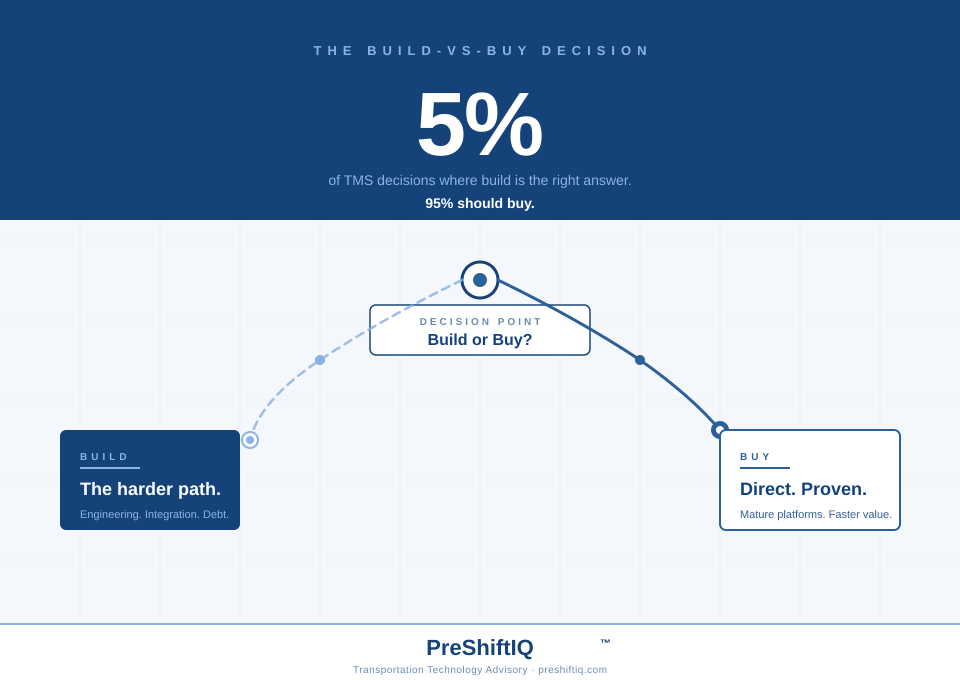
Build is the right answer in roughly 5% of TMS decisions. The other 95% should buy. AI lowering the floor of what is buildable does not change the ratio. It only makes it easier to start projects that should not be started.
The Real Cost of Building
When the build conversation starts, the line item that gets quoted is engineering cost. That is the wrong number to focus on.
The actual cost of building a TMS that handles a real operation includes engineering hires (typically two to four full-time, multi-year), product management and operational subject-matter expertise (rare and expensive), QA and testing infrastructure, security and compliance certifications (SOC 2, ISO 27001, regional data residency), ongoing maintenance (generally 25%–40% of original build cost annually), opportunity cost of senior leadership attention, and the strategic distraction from the actual business.
That last one is the real killer. Companies that succeed at logistics technology are companies whose business is logistics technology. Companies whose business is moving freight, manufacturing goods, or selling products almost never have the focus, the talent pipeline, or the institutional patience to build operational software well — even when they have the engineering budget.
Building a TMS is not a coding project. It is a sustained organizational commitment to running a software product. Most companies neither want that nor are good at it.
So What Should the Buyer Actually Do?
Buy. In almost every case, buy. But buy with discipline.
• Identify which TMS market cohort you are in — replacement, first-time digitizer, or new entrant. Each requires a different vendor profile.
• Define the operational problem you are trying to solve before evaluating any platform. Foundation first, technology second.
• Evaluate three to five vendors that fit your cohort, not the top fifteen industry-wide.
• Treat the implementation methodology as more important than the feature list. The 75% failure rate is not a feature problem.
• Reserve build effort for the 5–10% of your workflow that is genuinely differentiated. Layer it on top of a commercial TMS, not in place of one.
• Use AI tooling to accelerate analysis, documentation, and integration glue — not as a substitute for vendor selection rigor.
"The question is not whether you can build a TMS. With AI, most operators can. The question is whether you should — and whether building it is the best use of your time, your team, and your capital."
The Quiet Conclusion
AI changed what is possible to build. It did not change what is wise to build. Transportation technology is a discipline that rewards focus. Operators who try to do their job and run a software platform on the side almost always do both poorly.
Buy the TMS. Buy it carefully. Build only where you have a genuine competitive moat to protect. Spend the energy you would have spent building on getting your foundational alignment right — because that, not the technology, is what determines whether the platform you ultimately deploy actually pays back.
This is what PreShiftIQ™ does. Independent vendor audits across the TMS landscape. Buyer-side fiduciary advisory. Foundational alignment work that happens before any vendor demo. The assessment is free. The matching is fiduciary. The cost of getting build-vs-buy wrong is not.
Sources: PreShiftIQ vendor audit data (80+ vendors). U.S. TMS market sizing from Precedence Research and Global Market Insights (2025–2026). Internal PreShiftIQ analysis of 33 documented audits and engagement findings. The 75% TMS implementation failure-to-projected-ROI figure is documented in prior PreShiftIQ research.
