

Why I Built It
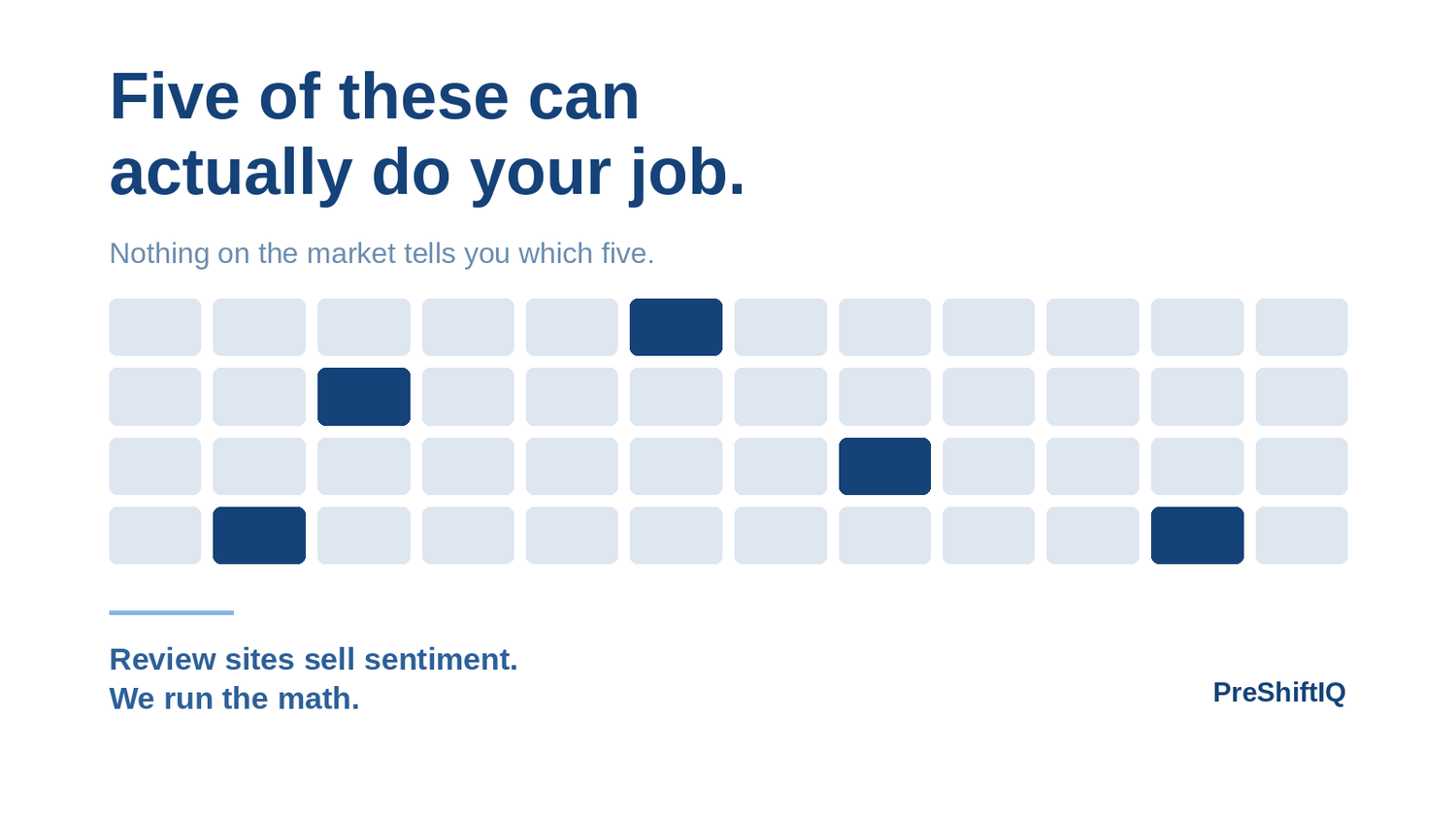
Buyers across the supply chain ecosystem are choosing technology on sentiment, from a field too crowded to evaluate. Neither problem is theirs to fix.
I have spent nearly thirty years in supply chain, most of it in carrier sales and operations and then in technology sales. Those are two very different seats, but they gave me the same view of one thing: I watched buyers choose systems, and I watched too many of those choices go wrong.
It was not because the buyers were careless, it was because the process is broken at the source.
Here is how a TMS selection actually goes. A buyer starts with a list pulled from a search, a conference, or a peer, and everything on it looks the same because every vendor site says the same six things. The buyer sits through eight or ten demos, each one a controlled performance, picks whoever demoed best, and finds out in month four what the system cannot do.
Gartner has put numbers to this, finding that 96% of software buyers start with a vendor list, that three in five regret the purchase inside 12 to 18 months, and that the organizations reporting high regret took 7 to 10 months longer to get through the process.
That is not a buyer problem, it is an information problem.
The tools that claim to fix it are selling sentiment, and the pitch is that somebody had a good experience so you will have a good experience. That does not follow, because their volume is not your volume and their modes, carrier base, and integration requirements are not yours. A five star review from a shipper moving parcel out of one DC tells a 3PL with 400 carriers across five modes absolutely nothing.
Ranking by opinion, paid or unpaid, is not a basis. It is a popularity contest with a logo on it.
Then there is the volume problem, because even a buyer who does everything right ends up with too many options, and Gartner ties buyer frustration directly to the number of options on the table. Ten vendors is not thoroughness, it is a committee that cannot agree, a calendar that slips two quarters, and a decision made on fatigue.
I built PreShiftIQ because the failure is structural, and it shows up the same way every time.
Buyers do not know their own operations as well as they believe, which is not a criticism, because nobody documents the exceptions, the workarounds, and the freight that moves outside the normal flow until someone asks the right questions.
Buyers also do not purchase technology often enough to get good at it, since a TMS decision comes around once every seven or eight years, which leaves no muscle memory and usually means whoever ran the last one has moved on.
And buyers do not have access to the vendors that could deliver them the most value, because the ones with the deepest fit for a particular operation are frequently the ones with the smallest marketing budget, so they never reach the list at all.
So the PreShiftIQ platform starts by removing rather than ranking. It consumes the attributes of the buyer's operation, meaning the modes and volumes, the systems already in place, the internal aptitude and resource constraints, and the requirements for both current and future states. Vendors that do not align to the needs and wants of a buyer are eliminated from contention before scoring begins, and the remaining vendors are stack ranked based upon their match to the unique buyer use case.
The buyer gets five, ranked on their own scorecard, with the reasoning behind every removal.
Five is a number a buying team can actually work, because five demos can be scheduled inside three weeks, five reference sets can actually be called, and five solutions can be measured against a single scope that belongs to the buyer. That is friction removed, not information withheld.
It is math, and math is hard to argue with, where opinion is easy to argue with, which is exactly why the market runs on opinion.
I am not writing this from a sales perspective. I have carried a number for most of my career and I know how enterprise deals actually get won, because personalities win and trust wins, and two vendors can be equally capable while the one the buyer connects with takes the deal. That is not a flaw, it is people doing business with people, and it is never going away.
The problem is when the bonding happens first.
A buyer sits through a strong demo with a sharp rep, likes them, and starts building the relationship before anyone has established whether the platform can manage the use case, so by the time the fundamentals get examined the buyer is invested in a person and the evaluation is no longer honest.
Start with logic, which is what the operation genuinely requires, what the vendor genuinely does well and what it does not, the real constraints, timeline, and cost. Get that aligned first and then go build the relationship, because the industry has the order backwards.
When both sides walk in aligned, everything downstream improves. The scope of work reflects reality instead of discovery guesswork, implementation moves faster because the surprises surfaced early, cost avoidance shows up sooner and holds, and the vendor stops burning cycles on deals that were never going to close.
Vendors pay us for outcomes and never for influence, which means nobody buys a ranking and nobody can.
This is the first in a series about building PreShiftIQ, covering what I got right, what a real buyer proved I got wrong, and what it takes for someone who has never written software to build an enterprise platform.
Choosing a TMS?
Complete a structured assessment of what your operation actually requires and get a shortlist ranked on measured fit, from a platform that works for the buyer. Vendors that cannot serve you are excluded before scoring begins. The buyer match is free.
Or read how the TMS match works at preshiftiq.com/for-buyers-tms.
Sources
- Gartner Digital Markets, 2024 Tech Trends Survey, 3,484 global software buyers.
- Gartner, technology purchase regret survey, 2022, 1,120 respondents across North America, Western Europe and Asia Pacific.
- Gartner, renewal and expansion buyer survey, 2023, 1,503 respondents, on option volume as a driver of buyer frustration.
Next in the series: the engine, and the day a real prospect broke it.
